Scaling from Etsy to Shopify: Protect Your Brand & Boost Sales
Ready to grow beyond Etsy? Learn a risk-free strategy to sync your listings, leverage low-cost Etsy ads for product validation, and instantly import reviews to Shopify to maximize conversions.
For many e-commerce entrepreneurs, the dream is owning a beautifully designed, highly profitable Shopify store. But launching a standalone website from scratch is notoriously brutal. You open your virtual doors, and... silence. No traffic, no trust, no sales.
That is why the smartest sellers don’t start with Shopify. They start with Etsy, master the marketplace, and then use a highly strategic, low-risk migration blueprint to build their independent brand.
If you want to scale your e-commerce business without burning thousands of dollars on unproven ideas, here is the exact roadmap to syncing Etsy and Shopify for maximum growth.
Phase 1: Etsy as Your Validation Engine and Low-Cost Testing Ground
The biggest hurdle for any new online store is finding buying traffic. This is where Etsy shines. Etsy isn't just a platform; it is a built-in search engine packed with millions of shoppers actively looking to buy.
When you launch a product on Etsy, the marketplace’s algorithmic traffic gives you immediate visibility and initial sales data that would take months to generate on a fresh domain.
The Secret Weapon: Etsy Ads as an R&D Tool
Many sellers view Etsy Ads simply as a way to boost sales. In reality, it is one of the most cost-effective product validation systems available.
Compared to the skyrocketing costs of Facebook Ads or Google PPC (Pay-Per-Click), where you can easily burn hundreds of dollars just to test a single creative, Etsy Ads costs a fraction of the price. Because the traffic is already hyper-targeted, a small budget on Etsy Ads will quickly tell you:
- Which designs people actually click on.
- Which variations convert into dollars.
- Which products have the potential to become true Best Sellers.
By using Etsy to absorb the initial risk, you ensure that you only invest heavily in inventory and branding for products that the market has already explicitly voted for with their wallets.
Phase 2: The Shopify Pivot — Moving from Marketplace to Brand Sovereignty
Once your Etsy shop stabilizes and you have identified 3 to 5 clear "Best Sellers," it is time to expand. Keeping all your eggs in the Etsy basket is a dangerous game. By launching a parallel Shopify store and focusing strictly on your proven Etsy winners, you unlock four massive advantages:
- Risk Mitigation (Anti-Deplatforming): Etsy is notorious for sudden, automated shop suspensions. If your Etsy store gets shut down overnight, your business vanishes. A Shopify store ensures you own your customer data and your platform.
- Escaping the Price Race to the Bottom: On Etsy, your product is surrounded by thousands of copycats. Buyers can easily scroll down and find a cheaper alternative. Shopify gives you a clean, distraction-free environment where you control the entire experience.
- True Brand Building: You cannot build long-term brand equity on a platform where customers say, "I bought this on Etsy" instead of "I bought this from [Your Brand]." Shopify allows you to tell your story and build genuine customer loyalty.
- Sales Channel Diversification: You transition from a simple marketplace seller to an omni-channel e-commerce brand.
The Golden Rule of Traffic: Stop Sending Paid External Traffic to Etsy
Once you begin doing social media marketing, running influencer campaigns, or buying paid ads, never point that traffic to your Etsy listings.
Here is why: when you pay to send a visitor to Etsy, you are driving them to a marketplace designed to keep them browsing. Etsy’s layout is packed with "Similar Items," "Sponsored Links," and competitor listings right underneath your product description.
If you use your own marketing power or paid budget to drive traffic to Etsy, there is a dangerously high probability that the user will get distracted and buy from your competitor. You essentially end up subsidizing your rival's marketing.
The Fix: All external traffic—whether from TikTok, Instagram, or paid ads—must land on your dedicated Shopify pages, where you retain 100% of the attention and 100% of the profit.
Phase 3: Solving the "Zero-Trust" Problem Instantly
When you launch your new Shopify store, you face a major roadblock: the lack of Social Proof. New visitors don't know you, and a store with zero reviews rarely converts. Building trust from scratch is exhausting and slow.
This is exactly where your hard work on Etsy becomes your unfair advantage. You don’t need to start from zero.
Instead of manually exporting CSV files or waiting months for Shopify buyers to leave feedback, you can automate the entire system using ReviewDock.
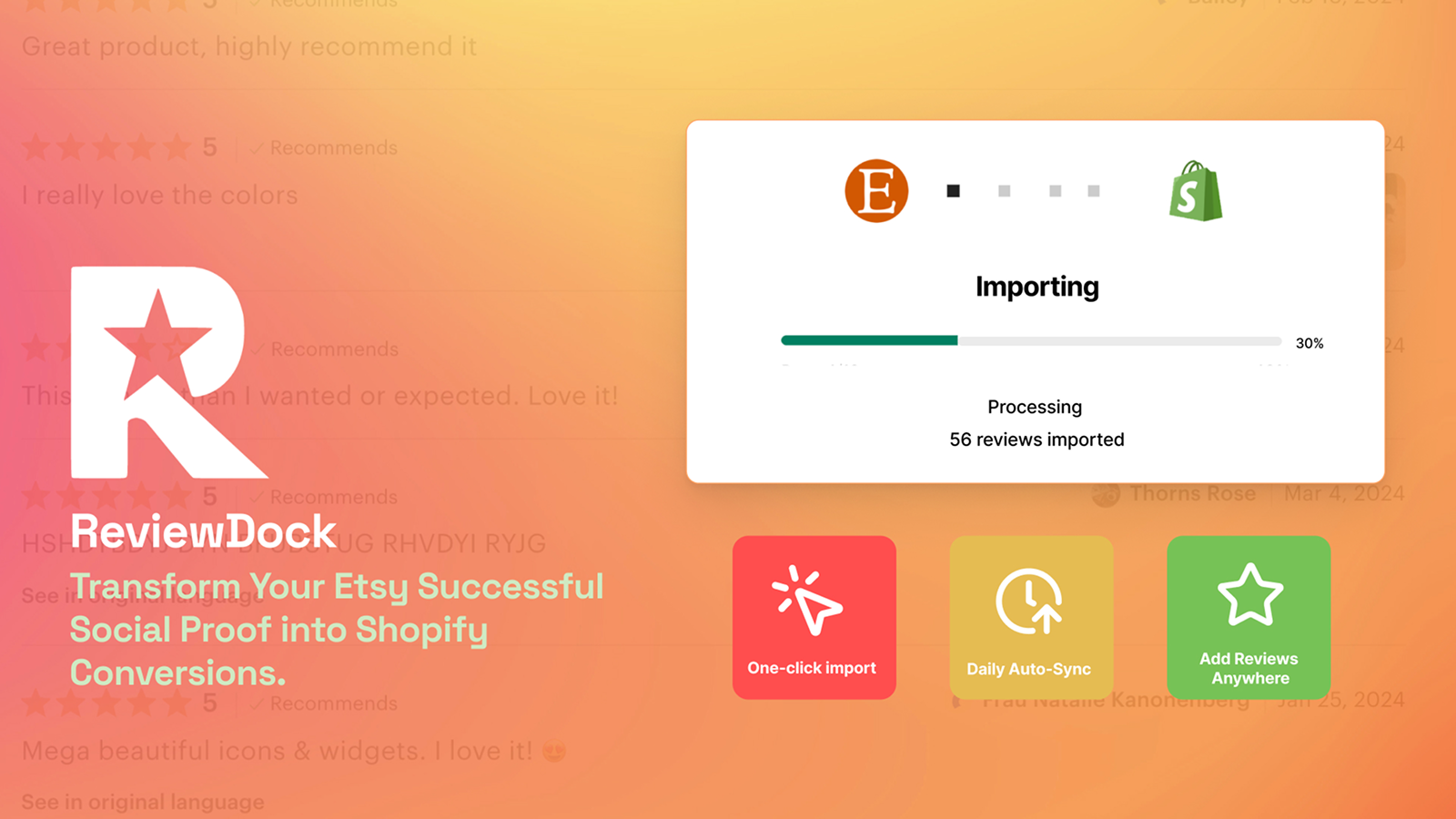
1.Install ReviewDock: Under 2 minutes.
Connect the ReviewDock app directly to your Shopify store with a few clicks.
2.Instant Historical Sync: One-time setup.
Automatically import all your existing, hard-earned Etsy reviews and map them directly to your corresponding Shopify product pages.
3.Set-and-Forget Daily Automation: Continuous syncing.
ReviewDock runs quietly in the background, automatically pulling in new Etsy reviews every single day as you receive them.
By instantly porting over your Etsy reputation, your Shopify store launches with established credibility. Not only does this skyrocket your conversion rates by making your new site look instantly trustworthy to human buyers, but rich product reviews also provide the structured data that helps search engines and modern AI shopping assistants discover and recommend your products.
Conclusion: Play Both Sides to Win
Don't look at Etsy and Shopify as competitors—look at them as teammates. Use Etsy for what it does best: low-cost validation, fast exposure, and reputation building. Then, use Shopify to build your empire, secure your assets, and scale your brand.
With your existing Etsy data and automation tools like ReviewDock to bridge the trust gap, you can scale a standalone storefront with total confidence.